
· by Michael Blair, Nashville's Irrigation
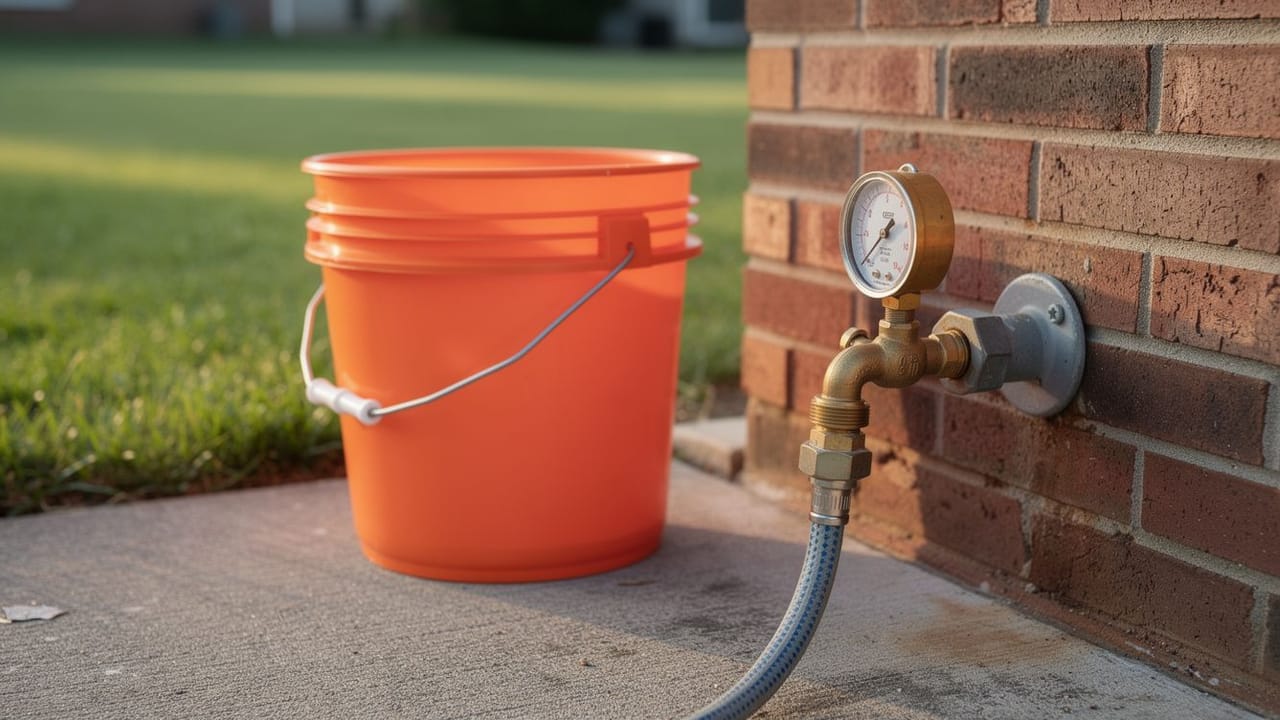
Most people picture a sprinkler install as trenching and heads. The part that decides whether the system works happens before any of that, standing at an outside faucet with a gauge and a bucket. Those two readings set how many heads can run at once, which sets how many zones the yard needs, which sets the controller and the valve manifold. Get them wrong and the result is a new sprinkler system with heads that barely pop up or zones that cannot reach their edges. Here is how the sizing works and why our crews measure before anyone draws a layout.
How much water pressure does a sprinkler system need?
Rain Bird’s guidance is that most automatic systems need 40 to 60 PSI to work properly; that figure comes from the maker’s homeowner planning guide, and the exact need depends on the heads chosen. The reading is taken with a gauge threaded onto an outside faucet and every other faucet in the house shut off, so nothing else is drawing water while the needle settles.
When the reading is taken matters too. Rain Bird’s guide points out that household pressure moves up and down over the day, so the useful number is the one at the hour the system will run. For most lawns that is early morning. We read it then, because a design built on a higher afternoon number can come up short at the hour it has to perform. It is the first step of every new sprinkler system installation we lay out.
How do you measure flow with a bucket?
Flow is measured by timing how long an outside faucet, opened all the way, takes to fill a 5-gallon bucket. Rain Bird’s guide gives the math: gallons divided by seconds, times 60, equals gallons per minute. A bucket that fills in 30 seconds means 10 GPM; one that takes 40 seconds means 7.5 GPM.
Pressure and flow are different questions. Pressure is how hard the water pushes when nothing is moving; flow is how much the service can deliver once it is open. A house can read a healthy number on the gauge and still fill the bucket slowly if the service line is small or long, and it is the flow that runs out first when too many heads share a valve. Rain Bird also notes your water utility can tell you the pressure at your address, which is a useful check against what the gauge shows.
- Shut off every other faucet and water-using appliance
- Read static pressure with a gauge on an outside faucet, at the hour the system will run
- Open the same faucet all the way and time a 5-gallon fill
- Gallons ÷ seconds × 60 = GPM
How many heads fit on one zone?
The number of heads a zone can carry is the available flow divided by what each head uses at the measured pressure. Rain Bird’s page on how many sprinklers can go on one zone works an example from its own catalog: its 5000 Series rotor with a 3.0 nozzle uses 3.11 GPM at 35 PSI, so a home with 10 GPM of capacity could run three of those heads on a zone. That example is the maker’s, for that one head; every head and nozzle has its own performance chart, and the chart for the head actually going in the ground is the one we size from.
Spray heads and rotors use water at very different rates, which is why they are not mixed on one valve. A zone of rotors on a wide back lawn and a zone of sprays along a narrow side yard each get sized against the same flow number, and they come out with different head counts. When a zone is loaded past what the service can supply, the heads at the far end of the run lose pressure first, and the edges of the lawn are where the dry patches that point to coverage problems show up.
Why a yard is split into zones instead of running at once
Flow is the first reason: almost no residential service can feed every head in a yard at the same time, so the system runs a few at a time and the controller steps through them. The second reason is what the water is landing on. The EPA’s WaterSense watering tips recommend grouping similar plants in the same zone, with sprinkler type, sun and shade and plant type each part of that grouping. A shaded fescue strip under oaks and a full-sun bermuda slope do not want the same minutes, and they cannot get different minutes if they share a valve. Beds usually go on their own zone, often as drip irrigation for planting beds.
Ground and slope count as well. The same EPA page warns that water pools on clay-rich soils and slopes when it goes on too fast, and suggests splitting run time into shorter cycles with breaks between them. Clay is what most Middle Tennessee yards sit on, so a zone on a slope gets its own valve and a cycle-and-soak program on the controller. WaterSense also asks that heads be set to keep water off sidewalks, driveways and the street, which shapes where the zone boundaries fall along the hardscape. A smart irrigation controller can handle the cycling, but only if the zones were drawn to allow it.
Every system on public water in Nashville also needs a backflow preventer near the meter, installed by a licensed plumber and inspected at installation and every year after, according to Metro Nashville Codes; our page on backflow testing and certification covers that step. The EPA’s WaterSense guidance on working with an irrigation professional puts design first among what a certified pro does: fitting the system to the landscape and the local climate. If you are planning a system and want the pressure and flow measured before anything is drawn, ask us for an estimate and we will start at the faucet.
Sources
- Rain Bird, How to Plan Your Automatic Sprinkler System — Maker’s guidance: most systems need 40 to 60 PSI; gauge test at an outside faucet; pressure varies through the day; bucket test and GPM formula
- Rain Bird, How many sprinklers can be used per zone or valve? — Heads per zone from pressure and flow; 5000 Series rotor example at 3.11 GPM and 35 PSI; check each head’s performance chart; the water company can give pressure
- U.S. EPA WaterSense, Watering Tips — Group similar plants in a zone by sprinkler type, sun and shade, plant type; pooling on clay and slopes; cycle and soak; keep water off pavement
- U.S. EPA WaterSense, Irrigation with a Pro — A certified professional designs the system for the landscape and local climate
- Metro Nashville Codes, Backflow Preventer Inspection — Irrigation systems require backflow preventers, installed by a licensed plumber near the meter, inspected initially and annually
FAQ
Sizing a New Sprinkler System: Pressure and Flow — questions
How do I test my water pressure for a sprinkler system?
Thread a pressure gauge onto an outside faucet, shut off every other faucet in the house, and open the one with the gauge. Read it at the hour the system will run, usually early morning, because household pressure rises and falls over the day and the design has to work at the lowest reading.
How do I measure GPM for a sprinkler system with a bucket?
Open an outside faucet all the way and time how many seconds it takes to fill a 5-gallon bucket. Divide the gallons by the seconds and multiply by 60. A 30-second fill works out to 10 gallons per minute, which is the flow figure each zone is sized against.
How much water pressure does a sprinkler system need?
Rain Bird, which makes sprinkler heads and controllers, says most automatic systems need between 40 and 60 PSI to work properly. That is the maker’s general guidance. The exact range depends on the heads and nozzles chosen, and each one’s performance chart shows the pressure it was built to run at.
How many sprinkler heads can you put on one zone?
Divide the flow your house delivers by what one head uses at your pressure. In Rain Bird’s own example, a rotor using 3.11 GPM at 35 PSI allows three heads on a zone for a home with 10 GPM. Different heads give different counts, so the answer comes from that head’s chart.
Why is a sprinkler system split into zones instead of running all at once?
A typical home service cannot supply enough flow for every head at once, so heads run a few at a time. Zones also group areas that need the same water: sun or shade, lawn or beds, sprays or rotors, flat ground or a clay slope that needs shorter cycles to keep from running off.