
· by Michael Blair, Nashville's Irrigation
Every other zone comes on when it should. One does not, and the grass in that part of the yard is showing it. The controller and the water supply serve every zone, so a single dead zone rules them out. The backflow preventer usually goes with them, though not always: Rain Bird’s valve troubleshooting guide points out that anti-siphon valves carry a backflow device of their own, while in-line valves sit behind one separate preventer. What is left is short: the wire to that valve, the solenoid on it, the valve itself, debris inside it, or a valve that was left in its manual off position or had its flow control closed. We check them in that order, cheapest first.
Where do you start when one zone won’t come on?
Run the zone from the controller’s manual start and stand at the valve box, if you know where it is. Rain Bird’s guide says the solenoid should make a distinct click when it is activated. No click and no water points to power or to the solenoid. A click with no water usually means the valve is not opening, though a solenoid clogged with grit can click and still fail to open it.
Inside the controller, we make sure the zone wire is seated in its terminal and the common wire is tight. Then a meter goes across the common terminal and that zone’s station terminal with the zone running. Rain Bird puts the reading at 24 to 30 volts, and its guide says that if you do not see it, the problem is in the controller. That is a controller repair or replacement, which is the work on our controllers page.
The wire
If the controller is putting out voltage, the wire between it and the valve is next. Rain Bird’s test for it is the same meter at the other end: across the common and the zone wire nearest the valve, with the zone running. Voltage at the controller and none at the valve means a shorted or broken wire somewhere in the run, to be repaired or replaced. Anything that digs along the path of a buried wire can cut it, and a splice that lets water in can fail without anyone touching it.
The splices in the valve box get our first look. Rain Bird’s HV valve manual calls for a watertight connector on each valve lead and recommends multi-strand, direct-burial wire, so a joint made with a bare wire nut and tape goes on our list right away. If the box checks out, we trace the run to find the break before deciding whether to repair it or pull a new wire.
- No click, no voltage at the controller terminal: controller output
- No click, 24 to 30 volts at the controller: wire or solenoid
- Click, no water: valve stuck with debris, or a torn diaphragm
- Weak flow only: flow control turned down, low pressure or a broken pipe
Where is the solenoid on a sprinkler valve?
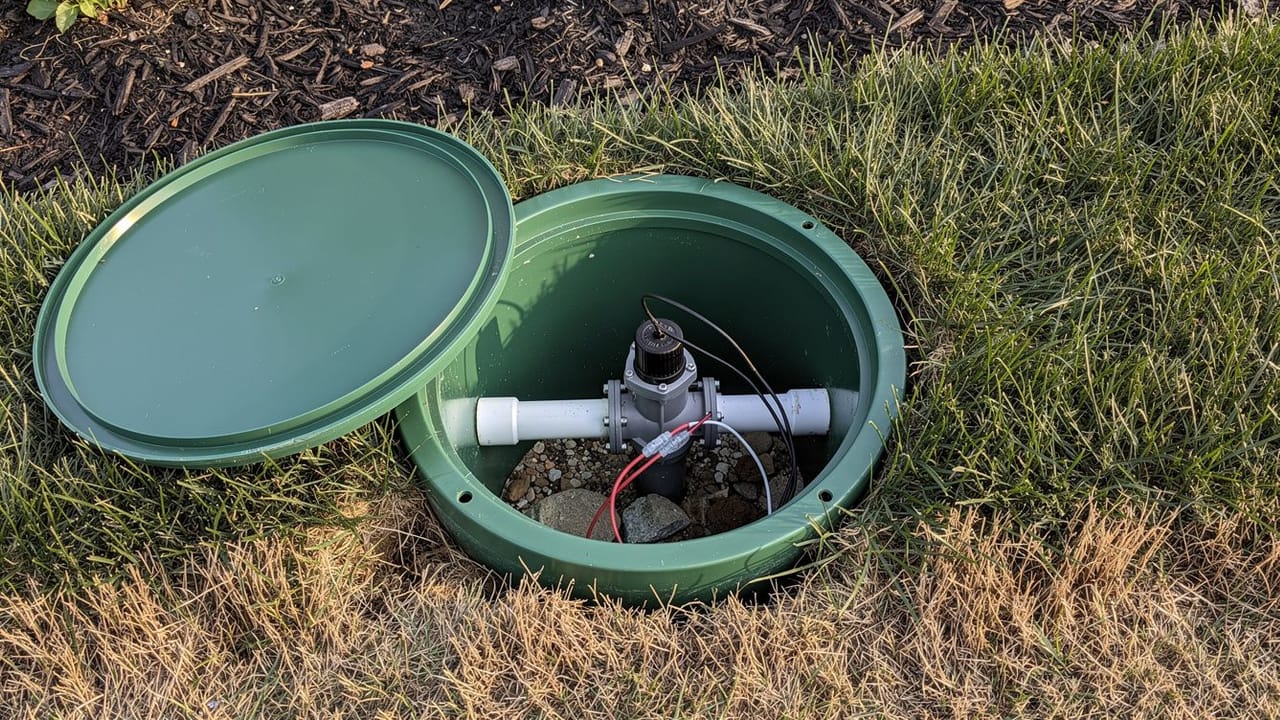
The solenoid is the black cylinder on top of the valve with two wires coming off it. Rain Bird’s own test needs no meter: swap it with the solenoid from a nearby valve of the same model and run the station again, and if the borrowed one opens the valve, replace yours. We also put a meter across its leads and compare the reading with the maker’s rating; Rain Bird’s spec sheet for the HV valve lists 70 to 85 ohms, and other brands and models list their own figure. To replace one, turn the zone off so no power reaches it, take off the wires and unscrew it.
On many valves, Rain Bird’s among them, you open the valve by hand by turning the solenoid a quarter turn counterclockwise. The guide warns against going past a quarter turn, because the solenoid can come loose and release pressurized water, and the HV manual says to tighten it fully afterwards by hand, without tools. Some valves use a bleed screw on the bonnet for this instead. If water flows, the valve works and the fault is electrical; if nothing comes, the valve is stuck.
Rain Bird traces a valve that will not open to a damaged opening mechanism or debris, with particular attention to the small bleed ports under the solenoid and on the face of the diaphragm, and to a torn diaphragm. Try the flush mode first: one turn of the bleed screw counterclockwise, no more, for a minute, then close it. If that does not clear it, shut off the water, take off the bonnet, inspect the spring, diaphragm and any filter, rinse the dirt away, clear the bleed port with a fine wire, and put it back with the spring in place. A torn diaphragm is replaced as a part. The guide also recommends a 100 mesh filter ahead of the valves on systems fed from a well, a lake or another dirty source.
When the zone is weak rather than dead
A zone that comes on but barely sprays is a different problem. EPA WaterSense’s Sprinkler Spruce Up checklist says to walk each zone looking for heads that do not pop up fully, and to watch between cycles for water pooling on the surface, which can mean an underground leak. Rain Bird lists the other causes of low pressure: a broken pipe, a main shutoff that is not fully open, too many heads on one line, or water being drawn somewhere else in the house while the zone runs. Then there is the flow control on top of the valve, on models that have one. It sets how much water passes through and does not turn the valve on or off; on Rain Bird’s HVF, turning the stem clockwise cuts the flow.
If the controller checks pass and the trouble is in the wire or the valve body, that is where our repair crews pick it up, and you can ask us for a free estimate. A zone that fails at spring start-up deserves a full wire and splice check rather than another quick fix, and our spring start-up post walks through the rest of that first run of the season. The opposite fault, a valve that opens and will not close, has its own post.
Sources
- Rain Bird, Troubleshooting and Maintenance Guide for Residential Automatic Valves & Valve Boxes (2016) — Anti-siphon versus in-line backflow; the solenoid click; 24 to 30 volts at the controller and at the valve; solenoid swap and replacement; quarter-turn manual opening; flush mode; disassembly and diaphragm; 100 mesh filter for dirty water; low-pressure causes; flow control
- Rain Bird, HV and HVF Series Valves installation manual — Watertight connectors and direct-burial wire; re-tighten the solenoid by hand; flow control clockwise reduces flow
- Rain Bird, Tech Spec: HV Series Valves (2013) — 24 VAC solenoid; coil resistance 70 to 85 ohms for the HV model
- U.S. EPA WaterSense, Sprinkler Spruce Up — Heads that do not pop up fully; water pooling between cycles as a sign of an underground leak
FAQ
One Irrigation Zone Stopped Working — questions
Why does one sprinkler zone not turn on?
Since the other zones work, the fault is specific to that zone: the controller output for it, the wire to the valve, the solenoid, or the valve itself, which may be clogged, have a torn diaphragm, or simply be set to manual off. Check for 24 to 30 volts at the controller terminal with the zone running, listen for the solenoid click, then open the valve by hand to separate the electrical side from the valve.
How do I test a sprinkler solenoid?
Rain Bird’s method is to swap it with the solenoid from a nearby valve of the same model and run the zone again; if the borrowed solenoid opens the valve, replace the original. A meter across its two leads should read close to the coil resistance the maker lists, which Rain Bird gives as 70 to 85 ohms for its HV valve. Turning the solenoid a quarter turn counterclockwise, and no further, opens many of these valves by hand, which tests the valve apart from the wiring.
Can a sprinkler valve be repaired instead of replaced?
Usually. Many stuck valves clear with the flush mode or once the bonnet is off and the diaphragm and bleed ports are rinsed. A torn diaphragm is replaced as a part, and a failed solenoid unscrews and is replaced with the zone switched off. A valve body or bonnet that is cracked or damaged is the case for replacing the valve.
Why does my sprinkler valve click but no water comes out?
A click with no water usually means the valve is not opening, though a solenoid clogged with grit can click and still fail. Debris in the bleed ports, a torn diaphragm, a valve set to manual off or a flow control turned down are the other suspects. Try the flush mode before taking the bonnet off.